Welcome to aubaine.ca!
Welcome to aubaine.ca!
Welcome to aubaine.ca!

By the aubaine.ca team · editorial direction: Marcel Dupont, founder · methodology
18 Aug 2026
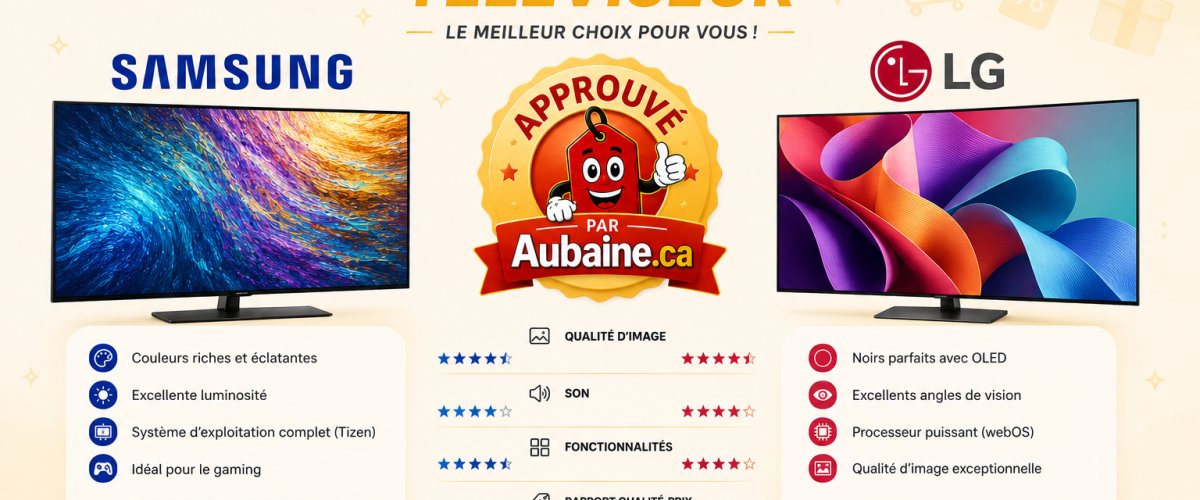
Torn between an OLED and QLED TV for your Quebec living room? It's a question thousands of Quebec families ask every year, especially during major sale periods like Black Friday and Boxing Day. Before checking the weekly flyers or comparing offers at Best Buy, Costco, or Future Shop, it's essential to understand the real differences between these two technologies and, most importantly, which one fits your environment and viewing habits.
An OLED screen has self-emissive pixels that produce their own light, offering absolutely perfect blacks and infinite contrast. In contrast, a QLED screen is a traditional backlit LCD with a layer of quantum dots added to enhance brightness and color saturation. The technological difference is fundamental and explains most of the practical differences you'll notice in your living room.
LG has dominated the OLED market for years, while Samsung reigns in QLED. However, other manufacturers like Sony, Hisense, and even LG itself offer high-quality QLED screens. In 2026, both technologies coexist in the Quebec market, each with devoted followers for good reasons.
Each pixel in an OLED shines independently. When a scene requires a black pixel, it shuts off completely, which is why blacks are truly black rather than gray like on other screens. This capability offers theoretically infinite contrast, since there's no upper limit to the brightness of a white pixel while a black pixel is literally off.
QLED uses traditional LED backlighting located behind the LCD panel. Quantum dots, tiny semiconductor crystals, amplify and refine colors for better overall brightness. Unlike OLED, a QLED screen can't produce true blacks since the backlighting is always partially active.
If you have a very sunny living room with large south-facing windows, QLED is often your best choice. If your space is a dimly lit basement or a room without windows, OLED will quickly become your preference. Environmental factors should carry the most weight in your decision, far ahead of spec sheet numbers.
A QLED screen produces raw brightness far higher than an OLED. When sunlight enters your living room directly, this extra brightness becomes essential to keep the picture readable and appealing. Glare on an OLED screen in natural light can be frustrating, while a high-quality QLED will handle this challenge effortlessly.
In a dark or dimly lit room, OLED shows its full potential. Perfect blacks create a cinematic atmosphere impossible to replicate with QLED, even high-end models. If you watch mainly in the evening or in a basement, OLED offers an unmatched visual experience. Most Quebec home theaters favor OLED for this reason.
Your favorite content type strongly influences the optimal choice. Movie lovers will benefit more from an OLED, while sports and gaming enthusiasts will sometimes find better value with a high-end QLED at the same price.
If you regularly watch 4K Blu-ray films, Netflix series, or high-quality content, OLED fully justifies its premium cost. The black bars on film, nighttime scenes, and subtle contrasts in dramas are rendered with a finesse that QLED can't match. Hollywood studios increasingly calibrate their content for OLED screens, meaning creators envision their films on this technology.
Hockey, football, basketball, and especially competitive video games demand high responsiveness and consistent brightness in well-lit scenes. An excellently tuned QLED often offers faster response time and higher peak brightness than an OLED, while costing less at the same size. Many Quebec online gamers prefer QLED for these technical reasons.
The distance at which you sit from your TV should determine its optimal size, and this equation doesn't affect your OLED or QLED choice, but it influences your overall budget and the perceived impact of the technology you choose.
If you have a typical small Quebec living room (for example, in Montreal or Quebec City, a 4 × 5 meter room with the couch 2 meters from the screen), a 55 to 65-inch screen is generally ideal. At this close distance, every screen imperfection becomes visible. An OLED's self-emissive pixels will shine here with admirable uniformity, while a QLED might show zones of imperfect backlighting.
In a large recreation basement with the couch 4 meters or more away, a 75-inch or 85-inch TV becomes crucial for an immersive experience. At this distance, QLED's minor backlighting flaws become imperceptible, and the cost advantage of high-end QLED (compared to entry-level OLED at the same price) can justify your choice.
Image retention, once a major OLED flaw, has been largely controlled by modern manufacturers in 2026. However, it remains a theoretical concern if you display the same static image for hours. Lifespan is another factor where OLED and QLED are converging, but not on all points.
Modern OLEDs incorporate compensation pixels and anti-retention algorithms that greatly reduce this risk. However, if you play video games with fixed interfaces (health bar, minimap, static channel logo), QLED spares you any worry. QLED backlighting doesn't wear out in localized areas, unlike OLED diodes which can fatigue unevenly.
Manufacturers typically warrant OLED and QLED TVs for 3 to 5 years in Quebec, covering manufacturing defects. In practice, a QLED often lasts longer without visible degradation, while a high-quality OLED can remain excellent for 7 to 10 years of normal use. The difference isn't as dramatic as some claim, but it does exist.
In 2026, a mid-size LG OLED screen costs roughly twice as much as an equivalent Samsung QLED outside of sales. However, during Black Friday and Boxing Day weekly flyer periods, the gaps shrink dramatically. This is precisely why savvy Quebec families plan their purchases around these times.
An LG 55-inch OLED with a few hundred dollars in discounts may end up at the same price as a discounted Samsung 65-inch QLED. In that case, the choice depends entirely on your space and usage. A sunny room with a large couch demands the bright 65-inch QLED, while a bedroom or basement better appreciates the refinement of a 55-inch OLED.
An OLED screen generally uses less power than an equivalent QLED because only displayed pixels produce light. During a dark movie scene, an OLED saves noticeably on energy. For daily intensive viewing, this difference adds up over months and can partially justify the initial premium.
Major electronics stores in Quebec — Best Buy, Costco, Future Shop, and others — adjust their prices and offers strategically throughout the year. Check the discount coupons and featured promotions to stay informed. Studies show families that plan around flyers save between $100 and $150 per month. For a TV, this impact can reach hundreds of dollars.
In late November, just before Black Friday, Quebec retailers launch aggressive promotions on OLED and QLED TVs. It's time to examine local retailers and compare detailed offers in the flyers. LG and Samsung typically reserve their best discounts for this period.
December 26 brings a second wave of promotions, particularly attractive for clearing winter inventory. Between these two peaks, September and October sometimes offer modest discounts, especially during new model launches. Check flyers regularly to stay in the loop.
In Canada, Reebee and Flipp are the two most-used flyer apps, letting you instantly compare prices at multiple Quebec retailers. Download them to receive discount alerts specifically for TVs and electronics. These free tools give you immediate access to pricing updated every Thursday.
Each Quebec region presents different housing conditions. In Montreal, where urban apartments are often more compact, a 55 or 65-inch OLED in a sunny living room is a challenge QLED handles well. In the suburbs and regions like the Laurentians or Upper Mauricie, where homes are larger and basements more developed, an OLED shines especially in a dedicated home theater.
Typical Montreal living rooms, especially in the Plateau, Griffintown, or Old Montreal, receive lots of natural light. High windows and southeast-facing exposures create a bright room. A bright 65-inch QLED is essential to maintain a sharp picture despite sun glare.
Quebec suburban families often have a finished basement for recreation. If your TV goes there, an OLED becomes an attractive option for movie lovers. If your main TV stays in the upper living room, a high-end QLED offers flexibility and brightness.
| Criterion | OLED | QLED |
|---|---|---|
| Blacks and Contrast | Perfect blacks, infinite contrast | Grayish blacks, high contrast |
| Raw Brightness | Moderate to good | Very high |
| Performance in Natural Light | Distracting glare | Excellent |
| Sports and Video Games | Good, variable response time | Excellent, fast response |
| Home Theater | Superior | Good |
| Image Retention | Low to moderate risk | No risk |
| Power Consumption | Low to moderate | Moderate to high |
| Theoretical Lifespan | 7 to 10 years | 8 to 12 years |
| Average Price (Before Discounts) | Higher | Lower |
| Brand Rankings | LG dominant, Sony, Hisense | Samsung dominant, TCL, Hisense |
| Profile | Room Lighting | Favorite Content | Recommended Size | Recommended Technology |
|---|---|---|---|---|
| Urban Movie Lover | Moderate to bright lighting | Movies, TV shows, 4K content | 55 to 65 inches | OLED (small room) or premium QLED (bright room) |
| Competitive Gamer | Moderate lighting | Video games, e-sports | 65 to 75 inches | High-end QLED |
| General TV Family | Bright lighting (living room) | Everything (sports, TV, movies) | 65 to 75 inches | Mid-range QLED |
| Home Theater Enthusiast | Low lighting (basement) | Movies, cinematic content | 75 to 85 inches | Premium OLED |
| Tight Budget | Variable | Variable | 55 to 65 inches | Budget QLED on sale |
In 2026, image retention on modern OLEDs is far less likely than it used to be. Manufacturers have built in compensation pixels and anti-retention systems. However, if you play video games with static interfaces (minimap, health bar), minimal risk remains. QLED has never had this problem.
No, it's not necessary. Sports fans benefit more from a high-end QLED, which offers peak brightness and fast response time for dynamic movement. A high-performing QLED at the same price as an entry-level OLED will serve you better for hockey, football, and basketball.
OLED generally uses less power than an equivalent QLED because only displayed pixels produce light. Over a year of intensive viewing, this savings adds up and can amount to tens of dollars, but it doesn't fully offset the higher purchase price of a high-end OLED.
Yes, a high-quality OLED (LG, Sony) will remain excellent after 5 years of normal use. Diode degradation is very gradual and imperceptible during that time. Most owners keep their TVs 5 to 7 years before upgrading, and an OLED will last that whole time without major issues.
Possible, but rare. Black Friday reduces prices on both technologies, but OLEDs generally remain more expensive. However, 55-inch OLED models or slightly older generations sometimes receive spectacular discounts. Check discount coupons and flyers a few days before Black Friday to spot these exceptional opportunities.
Before finalizing your purchase, take time to visit a Quebec store where you can see both technologies side by side. At Best Buy, Costco, or local retailers, ask to see a dark scene (blacks) and a bright scene on each model. This direct visual experience is worth more than any online article.
Bring a measuring tape to the store if possible. Note the exact distance between your couch and the wall where the screen will go. Ask the salesperson to show you the recommended sizes for that distance. A simple calculator (distance in cm divided by 1.5) gives you the ideal number of inches.
Don't judge a screen based only on demo video. Ask to see live sports content, a recent 4K film, and why not a video game session if you're a gamer. Each content type reveals different strengths and weaknesses of both technologies.
Buy from a reputable retailer offering a generous return period (minimum 30 days). Extended warranty or accidental damage protection may be worth the cost for such a significant investment. Read the fine print on dead pixel warranties.
If you're not in a hurry, wait for Black Friday or Boxing Day to buy. If you absolutely must buy earlier, look for special promotions through featured promotions or retailers offering unexpected discounts. Flyers change every Thursday, so check them regularly to seize opportunities.
An excellent TV poorly installed creates a bad experience. Check if wall mounting is included, assess cabling needs, and think about a good sound system (modern TVs often have weak speakers). These extra costs add to the initial purchase price.
Between OLED and QLED, there's no universal answer — only the one that's right for you. If your living room is flooded with natural light and you watch lots of sports, a high-quality QLED offers the best value. If you have a dark basement and love 4K movies, a premium OLED justifies its premium price.
In 2026, both technologies are reliable, high-performing, and accessible at various budgets, especially during major Black Friday and Boxing Day discounts. The key is to know your room, viewing habits, and priorities before checking flyers and special offers. With careful preparation and by regularly following weekly flyers, you'll easily find the perfect TV at a price you thought impossible.
💛 Our promise: helping you save. Despite all the care we put into tracking prices, we simply cannot guarantee they are accurate at all times — they come from flyers and merchants and can change without notice. Every week, we work to give you a fair and reliable picture so you can follow your products, spot real discounts and buy at the right time, at the best price. At aubaine.ca, every dollar saved matters: our mission is to hunt down the best deals for you. Always confirm the final price in store or with the merchant.
 English
  Français

Leave a Review