Welcome to aubaine.ca!
Welcome to aubaine.ca!
Welcome to aubaine.ca!

By the aubaine.ca team · editorial direction: Marcel Dupont, founder · methodology
18 Aug 2026
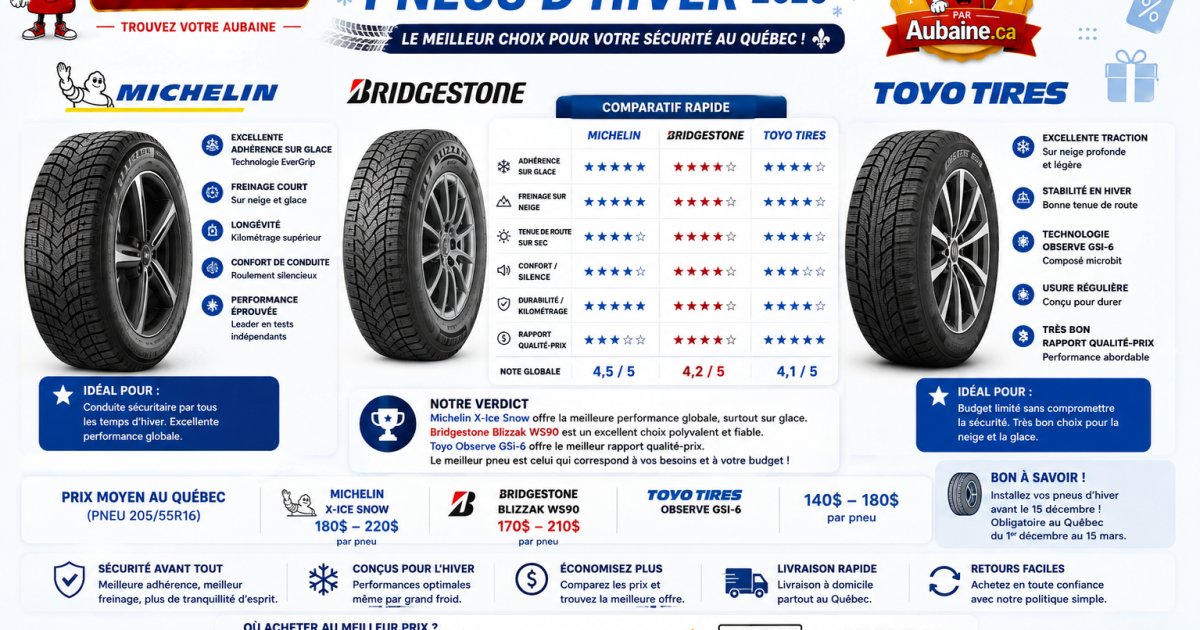
Since 2014, Quebec law requires tires bearing the mountain/snowflake pictogram (3PMSF) from December 1st to March 15th. But legality doesn't mean performance: should you invest in two seasonal tire sets or opt for a certified all-season compromise? In 2026, this question still divides Quebec vehicle owners. This article helps you decide based on your profile, region, and actual expenses.
The legal framework is clear: only tires bearing the mountain/snowflake symbol (3PMSF standard) or equipped with studs are accepted from December to March in Quebec. This requirement applies to all vehicles registered in Quebec, including taxis and motorcycles. The fine for non-compliance is $200 to $300, with limited exemptions: you have 7 days after purchase from a retailer to adapt, or you can obtain an exemption certificate from the SAAQ in specific cases (urgent work, relocation, etc.).
However, legality doesn't mean optimality. In recent years, several manufacturers offer "all-season winter-certified" tires that bear the 3PMSF pictogram and are therefore legal year-round. But unlike dedicated winter tires, these tires are a compromise: they try to perform in winter, spring, summer, and fall. It's precisely this compromise that forms the basis of your buying decision.
The winter requirement runs from December 1st to March 15th each year in Quebec. Those who drive with non-compliant tires after March 15th don't risk a fine, but those stopped between December 1st and March 15th with regular tires face a ticket. Plan your seasonal change a few weeks before the deadline to avoid lines at repair shops.
The mountain/snowflake pictogram (3PMSF) certifies that the tire passed traction and braking tests on snow according to ISO 19403 standards. An all-season certified tire bears this symbol if it meets these minimum thresholds. However, this doesn't mean its winter performance equals a dedicated winter tire: it simply means it clears the legal bar.
A dedicated winter tire is designed for snow, ice, and cold. Its rubber compound stays flexible at low temperatures, its tread patterns evacuate snow more efficiently, and its structure absorbs impacts better on frozen surfaces. In mountainous regions like the Laurentians or Outaouais, or in unplowed rural areas, this advantage can save lives.
Dedicated winter tires offer superior grip, braking, and cornering in snowstorms or icy roads. For someone living on a country road where snow isn't cleared quickly, or who must navigate mountain passes, this investment is justified by safety.
Investing in two tire sets means paying for two seasonal changeovers. Each change costs dozens of dollars, sometimes more if you balance and align. You also need storage space for the unused set. Finally, if you drive little in winter (remote work, backup vehicle), this cost doesn't spread well.
An all-season 3PMSF-certified tire lets you drive legally from October to April without seasonal changes. It's convenient, cheaper for installation (one set), and makes sense for a second vehicle or someone in a well-plowed suburb.
However, this tire doesn't rival a dedicated winter tire in extreme conditions. Its rubber is stiffer to work in summer, its design doesn't shed snow as effectively. On warm wet or dry roads, it performs better than a winter tire, but won't be as sporty as a specialized summer tire.
In heavy snow, thick ice, or icy climbs, an all-season certified tire will work but is less safe than a winter tire. You'll drive legally, but your safety margin shrinks. This is especially concerning since Quebec winter conditions can be unpredictable and brutal.
No one-size-fits-all solution exists. Your choice depends on where you live, how you drive, and what budget you can commit long-term. Let's look at four real profiles found in Quebec in 2026.
You drive the highway and regional roads regularly salted and plowed. Your winter commute looks like summer, just colder. An all-season certified tire is suitable: you get legality without extra cost, and public roads support you. One set is enough, and you skip seasonal changeovers.
Your municipal road is plowed only occasionally, or late. In winter, you often face fresh snow, black ice, and icy hills. A dedicated winter tire becomes a non-negotiable safety investment. The extra cost of two sets and seasonal changeovers is worth the peace of mind and certainty you can get home.
You have a main vehicle and an old car for emergencies. In winter, you'll drive little (remote work, car sharing, etc.). An all-season certified tire is plenty: the cost of double changeovers makes no sense for 3,000 km per winter, and your second car runs only sporadically.
You have a car mainly for weekends, family outings. In winter, you use it in plowed suburbs, rarely in mountains. An all-season certified tire is reasonable, especially since you benefit from systematic city snow removal.
| Criterion | Dedicated Winter Tire | All-Season Certified 3PMSF |
|---|---|---|
| Snow/Ice Performance | Excellent | Acceptable (legal minimum) |
| Warm Dry Road Performance | Fair (rapid wear) | Good |
| Wet Road Performance | Acceptable | Good |
| Total Lifespan (pair) | 3–5 years (alternating) | 4–6 years (continuous) |
| Initial Cost (two pairs) | Hundreds of dollars | Hundreds of dollars (1 set only) |
| Seasonal Changeovers/Year | 2 × ~$30–50 = $60–100 | $0 |
| Storage Required | Yes (1 set) | No |
| Safety on Snowy Mountain Roads | Very High | Acceptable |
| Legality in Quebec (Dec–Mar) | Yes (if bearing 3PMSF) | Yes |
To decide well, you can't compare purchase price alone. You must imagine your real use over 5 years and total all costs: purchase, installation, storage, premature wear from bad seasons. Here are two realistic scenarios.
You buy an all-season certified tire for a few hundred dollars. You never pay seasonal changeover fees ($0). Over 5 years, you may replace tires once (age and mileage wear). Total cost: new tires. With two dedicated sets, you'd have paid for both summer/winter sets plus double changeovers yearly = roughly double or more, even if tires last longer alternately.
You buy two specialized tire sets (hundreds each). Each fall and spring, you pay $60–$100 for changeover. Over 5 years: 2 sets + 10 changeovers = substantial cost. However, your safety in extreme conditions is maximum, and you sleep better at night. An all-season certified tire would have cost you less total, but you'd have less margin in a surprise storm.
Whether you choose winter or all-season tires, check the weekly circulars from major local retailers (Costco, Canadian Tire, Kal Tire, Crescent): prices fluctuate dramatically week to week, and September–November discounts can save you dozens of dollars. Use the price comparison tool to verify best rates before committing.
Quebec isn't uniform: the Island of Montreal doesn't resemble Gaspésie, and Quebec City suburbs aren't Outaouais. Your choice must account for local geography and snow removal reliability.
Roads regularly salted and plowed, mild winters by Quebec standards. An all-season certified tire generally suffices, unless you ski the Laurentians every weekend.
Longer, harsher winters. City snow removal is good, but secondary roads may stay snowy longer. All-season certified tires work, but a dedicated winter tire offers more comfort and safety in January–February.
Mountainous or narrow roads, variable snow removal by municipality. If you live on a country road, a dedicated winter tire becomes strongly recommended. Northern weather can change rapidly, and you don't want to get stuck.
Extreme climate, geographic isolation. Two dedicated winter tire sets aren't a luxury: they're a necessity to leave home in winter. Long distances and slow roadside help justify the investment.
If you opt for two seasonal sets, proper storage is crucial. Poorly stored tires age faster, crack, and lose their properties.
A winter tire loses its properties well before becoming bald. At 6 mm tread remaining (vs 1.6 mm legal for summer), you start losing 30% of ice grip. For Quebec winters, many specialists recommend replacement at 4 mm. All-season certified tires last a bit longer since you use them continuously.
No. Always check for the mountain/snowflake pictogram on the tire's sidewall. Many ordinary "all-season" tires don't bear it and are illegal in Quebec from December to March. Don't rely on the product name: it's the symbol that counts legally.
Between $30–$50 per axle, depending on the shop and region. Chains like Canadian Tire, Costco, and Kal Tire often offer competitive prices. Look for feature promotions in autumn to find the best changeover rates.
Legally yes, but it's a bad idea. Winter tires wear very quickly in summer (rubber too soft), overheat, and lose traction. You waste your money and increase blowout risk on hot roads. That's why many invest in two seasonal sets.
No, it's the opposite. Winter tires have higher rolling resistance than some all-season tires, slightly increasing consumption. In summer, it's very noticeable. A well-designed all-season tire will be slightly more economical.
A police officer can issue a $200–$300 ticket. You have 7 days after purchase from a retailer to comply (grace exemption). If you have a documented mechanical problem, you can request an exemption certificate from the SAAQ, but it's limited and specific.
Tire manufacturers invest increasingly in all-season technology. In 2026, 3PMSF-certified tires gain versatility through better rubber formulas and innovative tread designs. That said, physics is physics: a compromise will never match a winter tire's ice specialization.
Electric vehicles weigh more (battery) and have instant torque, stressing tires harder. Even with all-season certified tires, Quebec winters can be demanding. EV owners should seriously consider two seasonal sets, especially if they live outside the city.
Here's how to make your decision based on objective criteria.
Ask neighbors, coworkers, or friends who live in the same area what they use. Their local experience is gold. You may discover the whole country road uses dedicated winter tires for good reason.
If you inherit a car or buy a new vehicle, you can test an all-season certified tire one year in a plowed suburb, then evaluate if it suits you. If you find the experience risky or stressful, switch to two seasonal sets next year.
Quebec law only requires you to have a 3PMSF-certified tire from December to March. Whether it's dedicated winter or all-season, as long as it bears the mountain/snowflake pictogram, you're compliant.
The real choice is between maximum winter performance (two dedicated sets) and year-round convenience (one certified all-season set). A plowed Montreal suburb resident and a snowy Gaspésie country road owner don't have the same needs. Your safety, real savings, and peace of mind depend on this decision.
Remember: check retailers in your region and compare prices before autumn. Best deals happen in September and October, before the November rush. Whether you choose winter or all-season, buying smart remains the best strategy.
💛 Our promise: helping you save. Despite all the care we put into tracking prices, we simply cannot guarantee they are accurate at all times — they come from flyers and merchants and can change without notice. Every week, we work to give you a fair and reliable picture so you can follow your products, spot real discounts and buy at the right time, at the best price. At aubaine.ca, every dollar saved matters: our mission is to hunt down the best deals for you. Always confirm the final price in store or with the merchant.
 English
  Français

Leave a Review