Welcome to aubaine.ca!
Welcome to aubaine.ca!
Welcome to aubaine.ca!

By the aubaine.ca team · editorial direction: Marcel Dupont, founder · methodology
18 Aug 2026
Reusable diapers represent a significant upfront investment, but several Quebec municipalities offer purchase subsidies that can substantially reduce this burden. Before deciding, you need to add up the cost of a complete supply, extra washing costs over two to three years, and the possibility of reselling your equipment once your child is toilet trained. Unlike the common misconception that reusables are automatically more economical, everything depends on your local electricity rates, washing frequency, and ability to resell your equipment.
To use exclusively reusable diapers, you need a supply of 20 to 30 diapers depending on your child's age and how often you wash. This supply includes the diapers themselves (all-in-one systems, two-piece, or fitted) as well as additional absorbent inserts. Unit prices vary widely: some Quebec brands are cheaper than imports, but other premium options can cost several hundred dollars for the entire supply.
In Montreal, Quebec City, and Gatineau, several local businesses offer reusable diapers at competitive prices. The initial budget is evaluated at a few hundred dollars before municipal subsidies, which intimidates many parents. However, if your city offers a subsidy (some cover 50% to 75% of the purchase cost), the investment becomes much more accessible.
The reusable diaper subsidy program varies greatly from municipality to municipality in Quebec. Some cities offer direct purchase discounts (up to several hundred dollars), while others reimburse part of the costs after presenting receipts. Eligibility conditions often include a maximum family income, residency in the municipality for a certain period, or enrollment in a municipal sustainable development program.
Before investing, check directly with your city or local municipality. Municipal websites (for example Montreal.ca, Quebec.ca or Gatineau.ca) publish the criteria and eligible amounts. Some regions like the Outaouais and Mauricie have put in place more generous programs than others. Don't skip this step: it can cut your initial cost in half.
There are three main types of reusable diapers, each with its own economic and practical advantages. All-in-one systems (diaper + integrated absorbent insert) offer the greatest ease of use but cost more to buy. Two-piece systems (diaper cover + removable insert) slightly reduce the initial cost because you can reuse the cover multiple times before washing. Fitted diapers (pre-folded fabric) are the least expensive but require more developed folding skills.
For an average Quebec family, a hybrid supply (8-10 all-in-ones + 15-20 two-piece) offers a good balance between moderate initial cost and flexibility of use. Accessories (liners, specialized creams, wet bags) add a few dozen dollars to the initial budget.
Disposable diapers are among the most promoted items in Quebec flyers, particularly during Black Friday and Boxing Day. Pampers and Huggies dominate the market, but store brands (Compliments at Loblaws, Personnelle at Pharmaprix) offer excellent value for money and are often on sale before national brands. To reduce your monthly disposable diaper bill, the key is to plan your purchases around flyer promotions rather than shopping on impulse.
The two most used apps in Canada to access flyers in real time are Reebee and Flipp. These platforms let you check the week's deals by store and region, and even create automatic shopping lists based on promotions. At aubaine.ca, you'll also find all of this week's flyers in one place, which greatly simplifies your comparison.
The best times to buy diapers on sale are:
Pampers and Huggies alternate their promotions week to week in major flyers. To truly compare the unit price, you need to calculate the total price relative to the price per diaper, as the formats vary (boxes of 40, 80, 180 diapers). A small format box will always show a higher unit price than a giant package bought on sale.
Check aubaine.ca's price comparison tool to see current prices by store in real time. On average, a family-size format bought on sale costs a few cents per diaper, while regular price purchases cost about double. Store brands (Compliments or Personnelle) generally offer a better price even on sale, but don't work for all children (skin sensitivity, fit).
Compliments (Loblaws' store brand, available in Loblaws, Provigo and Extra stores) and Personnelle (Pharmaprix's store brand) are consistently 20 to 30% cheaper than Pampers or Huggies. During a promotional flyer, the gap often reaches 40 to 50%. While the perception is that national brands offer better comfort, customer feedback shows that the majority of babies adapt without issue to store brands.
A winning strategy for Montreal and Quebec families: try a small box of store brand, and if the baby tolerates it well, switch entirely during sales. You save several hundred dollars over 24-36 months while maintaining the same level of absorption and safety.
To fairly compare the two systems, you need to project costs over 24 to 36 months (until toilet training). The calculation changes dramatically depending on whether you accept a hybrid model, a disposable-only model, or exclusively reusable diapers. Variables that influence the final result include municipal subsidies, local electricity rates, the possibility of reselling reusables, and daycare acceptance.
Here's a simplified comparison table based on typical 2026 Quebec figures:
| Criteria | 100% Disposable (on sale) | 100% Reusable (with subsidy) | Hybrid (reusable at home + disposable out) |
|---|---|---|---|
| Initial Investment | Minimal (1-2 boxes) | A few hundred dollars (reduced by 50-75% if subsidy) | A few hundred dollars (smaller supply) |
| Monthly Recurring Costs | A few dozen dollars if regular sales | Electricity + water (approximately $10-20 / month) | Electricity + water ($5-10) + disposables out ($10-15) |
| Total Cost 24 Months | A few hundred dollars (varies by sales) | A few hundred dollars (after subsidy + utility costs) | A few hundred dollars (balanced compromise) |
| Resale at End | Zero (waste) | A few dozen dollars ($50-150 depending on condition) | A few dozen dollars (smaller supply) |
| Daycare Acceptance | Automatic | Variable (check first) | Recommended (avoids conflicts) |
Reusable diapers require 2 to 3 additional loads per week (some families do more). Each complete cycle (wash + dry) consumes electricity and water. While the cost per cycle is low (a few dollars), multiplied over several years, it represents a real expense that is often forgotten in the "magic" cheap reusable diaper calculation.
In Montreal, the water bill can increase by $10 to $20 monthly with daily diaper loads. In Quebec City and Gatineau, water rates vary by municipality: some Quebec City sectors charge by volume, which increases the impact. Electricity varies by region (Hydro-Québec offers some of the lowest rates in North America, which favors reusables). The personal time investment (soaking, folding, arranging diapers) is not billed, but also represents a "cost" to consider.
Disposable diapers require storage space at home: a box of 180 diapers takes up significant volume, and many families stock several to take advantage of sales. Some Montreal or Quebec City neighborhoods charge for waste by volume (for example, fees per bag or by weight), which increases disposal costs compared to families in rural areas with flat-rate collection.
Also, impulse purchases of small boxes (at the corner pharmacy, convenience store) without waiting for flyer sales double or triple the cost per diaper. Several parents admit they buy at full price 20% to 30% of the time, which erodes the savings from sales.
To illustrate the calculation concretely, here are three typical Quebec family profiles in 2026:
| Profile | Strategy | Context | Estimated 24-Month Cost | Advantages | Challenges |
|---|---|---|---|---|---|
| Urban Montreal Family | 100% Disposable Sales | Two children, daycare accepts disposables, limited storage space | A few hundred dollars (with regular sales) | Zero management effort, flexible daycare, simple | Higher waste costs, limited space |
| Eco-Conscious Gatineau Family | 100% Reusable | One child, house with space, city offers subsidy, no daycare | A few hundred dollars (reduced by subsidy + resale) | Municipal subsidy, resale possible, minimalist | Regular washing costs, learning curve, long-term commitment |
| Pragmatic Quebec City Family | Hybrid (Reusable at Home + Disposable at Daycare) | One child, daycare refuses reusables, parent at home 2 days/week | A few hundred dollars (balance of both) | Flexibility, daycare satisfied, smaller supply so cheaper | Managing two systems, coordination at changes |
Most Quebec daycares accept disposable diapers without condition, but categorically refuse reusables. Reasons cited are hygiene, lack of storage space between changes, and the workload of staff (who must handle soiled diapers differently). Before committing 100% to reusables, check your daycare's policy: this detail can invalidate three years of economic calculation.
Some private daycares or family childcare providers are more flexible, particularly in regions like the Outaouais and Mauricie where eco-consciousness is stronger. However, even if accommodating, they may ask that diapers be pre-packaged, which adds cost or preparation work.
If your daycare refuses reusable diapers, some parents manage to negotiate a compromise: use reusables for the first two morning changes (before the educator arrives) and in the evening (after leaving), and provide disposables for the full day. This system reduces the volume of disposables purchased (so sales are more than enough) and offers real savings without conflict with the facility.
Other daycares accept reusables if the parent provides a closed container to store soiled diapers, eliminating odors and reducing the management burden. Before giving up on the idea completely, speak directly with management: you'll be surprised at how many creative solutions are possible.
Many Quebec families find their balance with a hybrid approach: reusable diapers at home (where the parent controls the process and benefits from resale at the end), and discounted disposables at daycare and outings. This solution solves several problems at once: it satisfies the daycare, reduces the volume of disposables purchased (so sales are enough), and keeps the initial investment manageable.
With a smaller reusable supply (15-20 diapers instead of 25-30), the initial investment stays moderate, washing costs decrease (less frequent loads), and resale generates better returns (diapers less worn). The total cost over 24-36 months often balances between the 100% disposable and 100% reusable costs, but with added flexibility.
Major Quebec retailers (Walmart, Costco, Loblaws/Provigo, Pharmaprix/Jean Coutu) vary their diaper promotions in each flyer. To optimize your budget, you need to combine several strategies: follow regular sales, stack coupons, take advantage of loyalty programs, and buy in giant formats during peak sales. Families who plan purchases around flyers typically save $100 to $150 per month.
Regularly check the discount coupons available on aubaine.ca, as manufacturers (Pampers, Huggies, Pamtex) offer direct reductions several times a year. Combined with flyer discounts, these coupons can cut your bill in half on certain purchases.
Buying large quantities on sale seems logical, but carries risks: you won't know if this size or brand works for your child until you've tried it. Buying 180 diapers of a brand your baby rejects (irritation, leaks) is a costly waste. Start with small quantities when first trying a brand, then switch to the giant format once you've confirmed it works.
Also, expiration dates exist on diapers (though rarely displayed). Stock bought 8 months ago and still in a corner of the storage room won't offer the same absorbency. Manage your stock as rotating inventory (FIFO: first in, first out).
Walmart, Loblaws, Costco and Pharmaprix all offer loyalty programs that accumulate points on diaper purchases. These points convert to future discounts, indirectly extending your monthly savings. If you consolidate purchases at a single major retailer (rather than splitting between three or four), you accumulate faster and maximize your returns.
Also check the list of participating retailers and their specific programs. Some offer bonus points or doubled discounts during strategic periods (Christmas, back-to-school).
In Montreal, the most aggressive discounts are typically found at Walmart Supercentres, Costco and Loblaws (especially during Black Friday). In Quebec City, the same chains dominate but prices vary slightly by area. In the Outaouais, Gatineau offers access to Ontario markets, creating more intense price competition. Check the flyers for your specific region each Thursday to identify this week's best price.
While the core of this article is economic, it's honest to note that environmental motivations also drive families toward reusables. Each baby generates several tons of disposable diaper waste over 24-36 months. Reusable diapers dramatically reduce this impact, especially if you benefit from cheap hydroelectric power (like in Quebec with Hydro-Québec).
Conversely, frequent washing consumes water and electricity, creating another type of environmental impact. The ecological calculation is therefore nuanced: neither 100% reusables nor 100% disposables constitutes the perfect "green" solution. Hybrid represents a good compromise environmentally as well.
Yes, if they're in good condition, well maintained, and show no permanent stains or wear. Quebec classifieds (Facebook groups, aubaine.ca's marketplace classifieds) are full of buyers for used reusable diapers at reduced prices. You can typically recover 30 to 50% of the initial cost if your diapers are clean and functional. However, don't count on this for your main calculation: it's a potential bonus, not a guarantee.
The jumbo format (200+ diapers) always offers the best unit price, provided you have storage space and buy during a sale. A small format at regular price costs about double (or more) the same number of diapers in a reduced family package. If your storage is limited, buy two jumbo formats during two different sales and stagger them over two months.
Absolutely normal. The majority of Quebec daycares refuse reusable diapers for hygiene, storage space, and staff workload reasons. Before committing to reusables, ask your daycare directly about its policy. If it categorically refuses, the hybrid model (reusable at home only) becomes your best option.
Black Friday (late November) and Boxing Day (December 26) offer the year's most aggressive discounts, often with additional coupons. Plan a major purchase during these periods to cover 4 to 8 weeks of consumption. Between these peaks, buy opportunistically based on the week-by-week sales published in flyers.
Yes, on average. Store brands Compliments (Loblaws), Personnelle (Pharmaprix) and others are consistently cheaper than Pampers or Huggies, even without additional sales. During flyer sales, the gap widens further. The quality is adequate for the majority of children, but some babies are more sensitive or prefer the premium comfort of a national brand. Test in small format before committing.
No, but a washing machine with a "delicate" or "hot water" cycle helps a lot. Reusable diapers tolerate standard washing well, but require complete rinsing to remove soap and urine residue. An old washing machine does the job, but may wear diapers faster. Also consider that some families use reusable diapers for years across multiple children, which justifies investing in a good washing machine when replacing one anyway.
In 2026, the choice between reusable and disposable diapers is no longer binary. Quebec families have access to municipal subsidies, well-documented regular sales, and hybrid strategies that didn't exist ten years ago. The real calculation depends on your specific context: daycare, storage space, local water and electricity rates, your child's sensitivity, and your availability to manage a reusable supply.
Before investing, sign up for digital flyers (Reebee, Flipp, and aubaine.ca), check if your municipality offers a subsidy, and ask your daycare about its policy. These three steps take 30 minutes and will save you hundreds of dollars and future regrets. The most substantial savings rarely come from choosing between reusables and disposables, but rather from shopping discipline around flyer sales and refusing regular prices. Check our featured deals regularly to identify the best discount opportunities for your region and diaper type.
💛 Our promise: helping you save. Despite all the care we put into tracking prices, we simply cannot guarantee they are accurate at all times — they come from flyers and merchants and can change without notice. Every week, we work to give you a fair and reliable picture so you can follow your products, spot real discounts and buy at the right time, at the best price. At aubaine.ca, every dollar saved matters: our mission is to hunt down the best deals for you. Always confirm the final price in store or with the merchant.
 English
  Français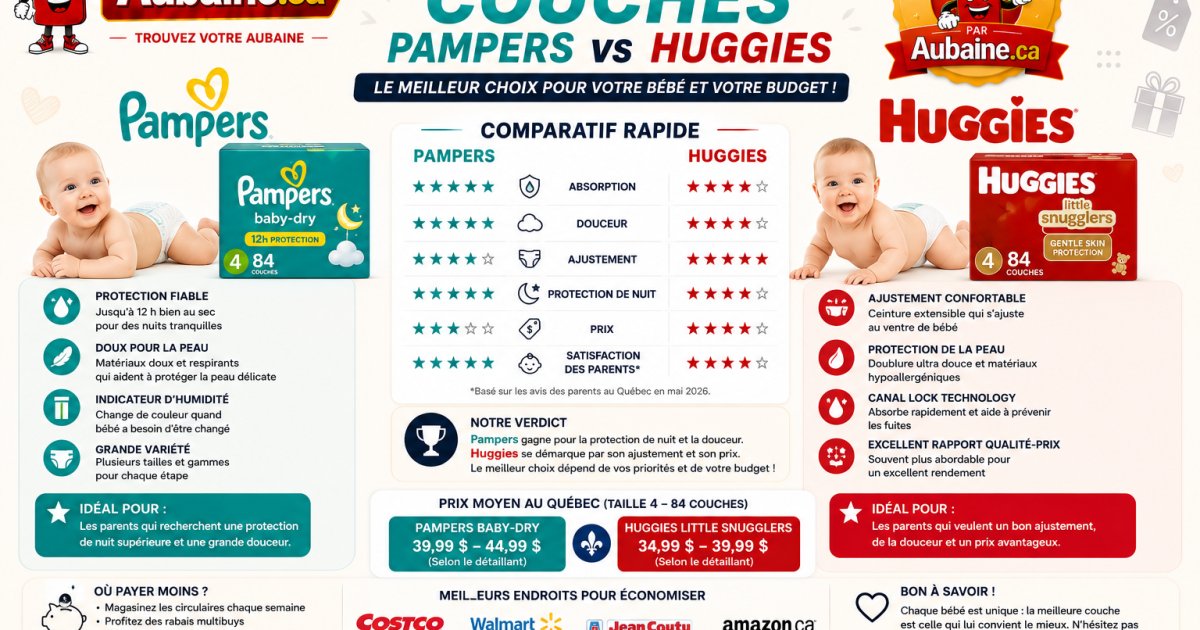

Leave a Review